










By: Derek Ellis
SAN DIEGO (BTVN) — A spacecraft carrying humans returning from the vicinity of the moon streaked through Earth’s atmosphere and splashed down in the Pacific Ocean, marking the United States’ first crewed lunar mission in more than 50 years and a major step toward a sustained human presence beyond low-Earth orbit.
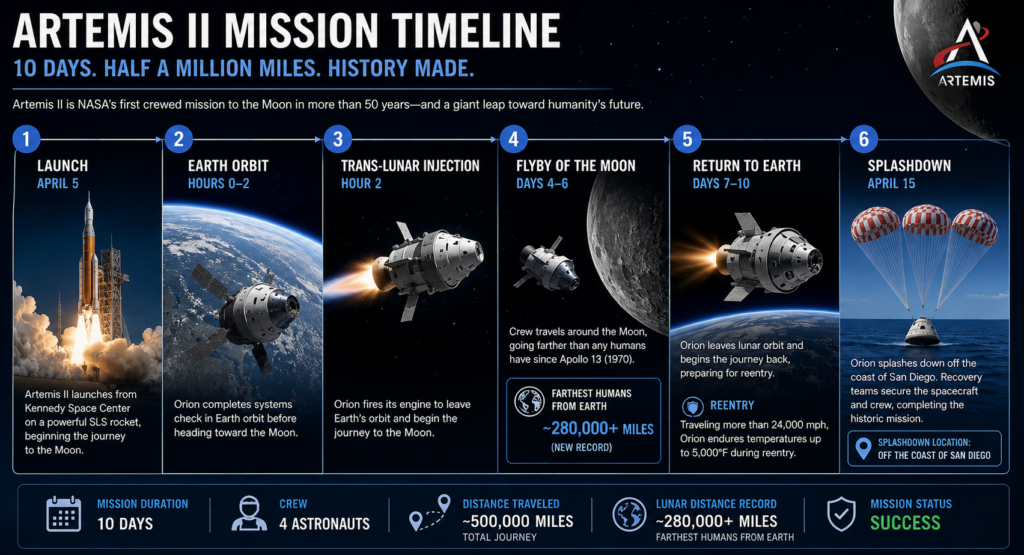
NASA’s Orion capsule, concluding the 10-day Artemis II mission, parachuted into waters off the coast of San Diego, where recovery crews quickly secured the spacecraft and began post-landing procedures. The four astronauts aboard emerged as the first humans to travel around the moon since the Apollo era, completing a journey that took them roughly half a million miles through deep space.
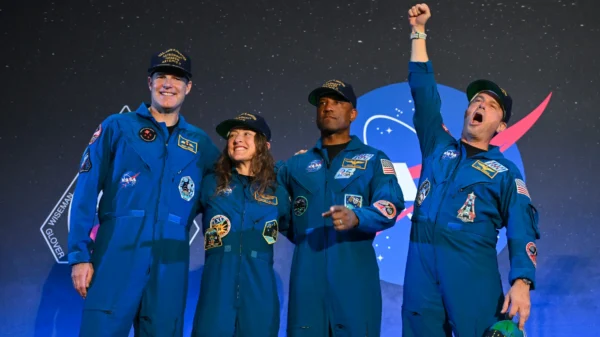
“It’s good to be home,” Commander Reid Wiseman said over mission communications after splashdown, as applause broke out among engineers and flight controllers monitoring the return.
The successful mission is widely seen as a cornerstone of NASA’s Artemis program, an ambitious effort to return astronauts to the moon later this decade and establish a long-term presence that could serve as a proving ground for eventual missions to Mars.
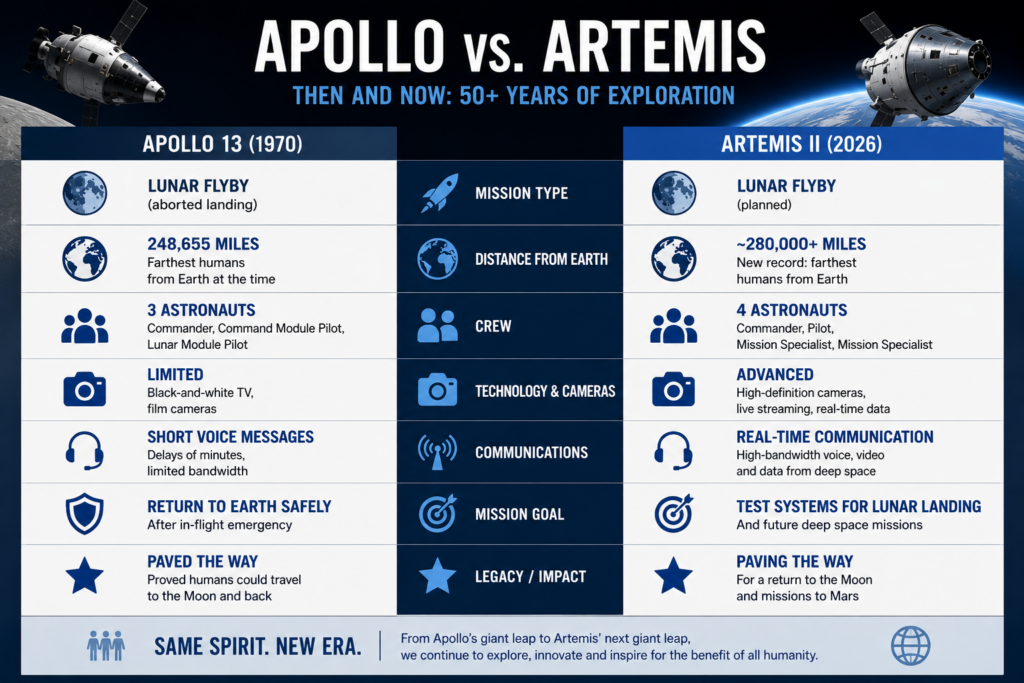
The Artemis II crew did not land on the lunar surface, but their voyage pushed human spaceflight farther than it has gone in generations. During the mission, they set a new record for the greatest distance traveled from Earth by humans, surpassing the mark set during Apollo 13 in 1970.
“This is what it looks like when preparation meets opportunity,” said Jeff Radigan, the lead flight director for NASA’s Artemis II mission, during post-splashdown remarks. “We’ve demonstrated that we can send humans safely into deep space and bring them home.”
The return began hours earlier, as Orion executed its final maneuvers before reentry. Traveling at speeds exceeding 24,000 miles per hour, the capsule endured temperatures approaching 5,000 degrees Fahrenheit as it hit the upper atmosphere, protected by its heat shield. A series of parachutes deployed in sequence, slowing the spacecraft for a controlled descent into the ocean.
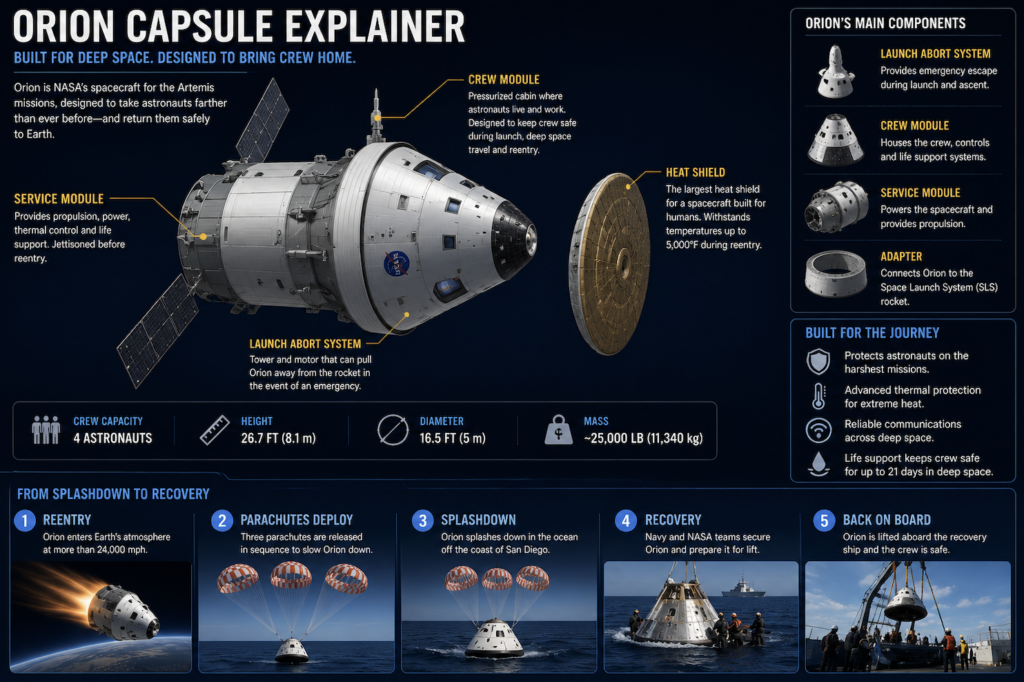
Navy and NASA recovery teams, stationed in advance of the landing, moved in swiftly once Orion touched down. Within minutes, divers secured the capsule, and a recovery vessel began preparations to lift it aboard.
Officials said the astronauts were in stable condition and would unergo routine medical evaluations before being transported to NASA’s Johnson Space Center in Houston.
The mission’s success follows years of development, delays and testing, including the uncrewed Artemis I flight that orbited the moon in 2022. Artemis II represents the program’s first test with astronauts aboard, validating life-support systems, navigation and communication capabilities in deep space.
Beyond its technical achievements, the mission has rekindled public interest in lunar exploration.
Across the United States, crowds gathered to watch key moments of the flight, including the splashdown. At Seattle’s Museum of Flight, hundreds of space enthusiasts followed the mission’s final moments on large screens, reacting in real time as Orion descended into the Pacific.
“This look of relief tells the story,” said Sebastian Robertson, who was at the museum as the capsule returned. “The Orion capsule is back on Earth. The first crewed mission to the moon in more than 50 years was a success.”
For many, the Artemis II mission has stood out not only for its historic nature but also for its unprecedented accessibility. Advances in technology allowed the public to follow along more closely than during the Apollo missions, with frequent updates, live video and high-resolution images transmitted from deep space.
“What we’ve seen in the last 10 days has been unprecedented,” said Connor Roestel of the Museum of Flight.
Those images included detailed views of the moon’s surface, capturing ancient lava flows and craters in striking clarity, as well as shots of Earth appearing as a distant blue sphere against the blackness of space.
“It’s just wild to watch it with the technology that we have now,” said Jessica Young. “To be able to watch them in space the whole time they’re there, checking in, seeing it happen live in front of us is huge.”
The astronauts themselves also contributed to the mission’s widespread appeal, sharing moments that highlighted the human side of space exploration.
“Oh, and the selfie they took from the solar array looking back at the capsule with their faces in the windows,” said Steve Rice. “I mean, that just makes it so much more real.”
NASA officials have emphasized that Artemis II is a precursor to more complex missions ahead. Artemis III, currently planned for later this decade, aims to land astronauts near the moon’s south pole, where scientists believe water ice may exist in permanently shadowed regions.
Future missions are expected to build on that foundation, including the development of the Lunar Gateway — a space station that would orbit the moon — and surface habitats designed for longer stays.
Connor Roestel said the mission’s broader importance lies in its ability to inspire. “We’ve always for centuries, we’ve wanted to gaze at the stars, we’ve wanted to walk in the sky like birds,” he said. “That’s always been a fascination, that curiosity. This is what has led us to this moment with Artemis II.”
Back in San Diego, the scene following splashdown was a mix of precision and celebration. Recovery crews worked methodically as helicopters hovered overhead and support ships maintained position in the Pacific.
For NASA, the successful return of Artemis II marks both an ending and a beginning — the conclusion of a landmark mission and the start of a new era in human spaceflight.
More than five decades after Apollo astronauts last ventured to the moon, Artemis II has demonstrated that deep space is once again within reach.
And as the Orion capsule was hoisted from the ocean, water cascading from its scorched exterior, it offered a vivid reminder of what had just been accomplished: a journey to the edge of humanity’s past and the threshold of its future.